
How it Works
Rethink Photochemistry. The Reactor is Now Wireless and Inside.
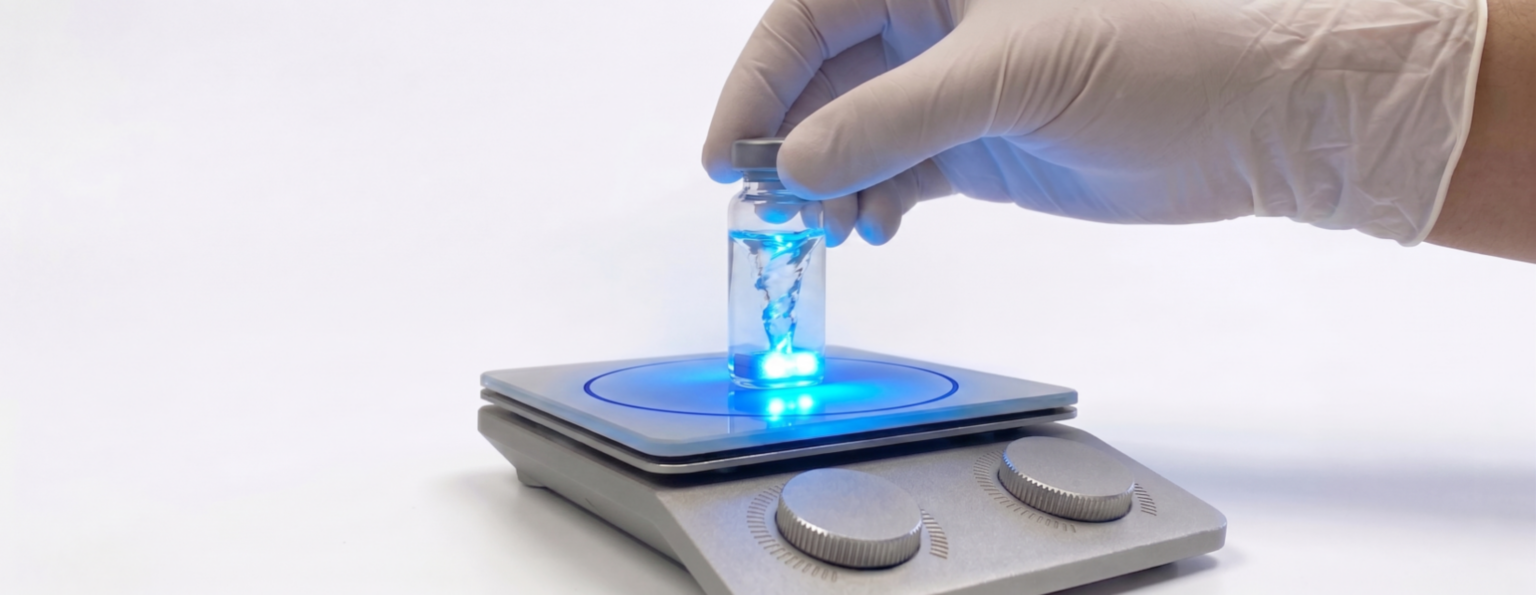
Energy Harvesting
Traditional immersion lamps require vessel adapters and cables. We get rid of adapters and cut the cord entirely.
By harvesting rotational energy from magnetic stirring plates, the Photonic Stir Bar wirelessly receives continuous, stable power without requiring additional sending modules or other appliances.
Zero-Interface Logic
The integrated smart control logic automatically detects the presence of the magnetic stirrer and switches between pure stirring and combined illumination. No external interfaces to program, no touch screens to contaminate. Just drop it in, put it on your stirrer, and the reaction begins.
Maximized Photon Delivery
External lamps lose up to 99% of their energy to poor surface area exposure, reflection, and glass walls. By bringing high-flux LED emitters directly inside the reaction mixture, we bypass these obstacles. The result? – A reproducable, zero-setup internal light source instead of external lamp clutter.
References
Check out these key publications to better understand the decisive factors behind optical efficiency and why wireless internal illumination is the logical next step for photochemistry.
Specifications
Power Supply
Wireless Energy Harvesting
Modes
(1) Stir-Light (2) High-Speed Stirring
Shell & Size
Fluoropolymer, 12 x 19 mm
Internal Photon Delivery
0.1 – 0.5 mmol/h
Stirring Speed
0 – 3000 RPM (Mode Dependent)
Operating Range
–20 to +80 °C
Limitless Setups
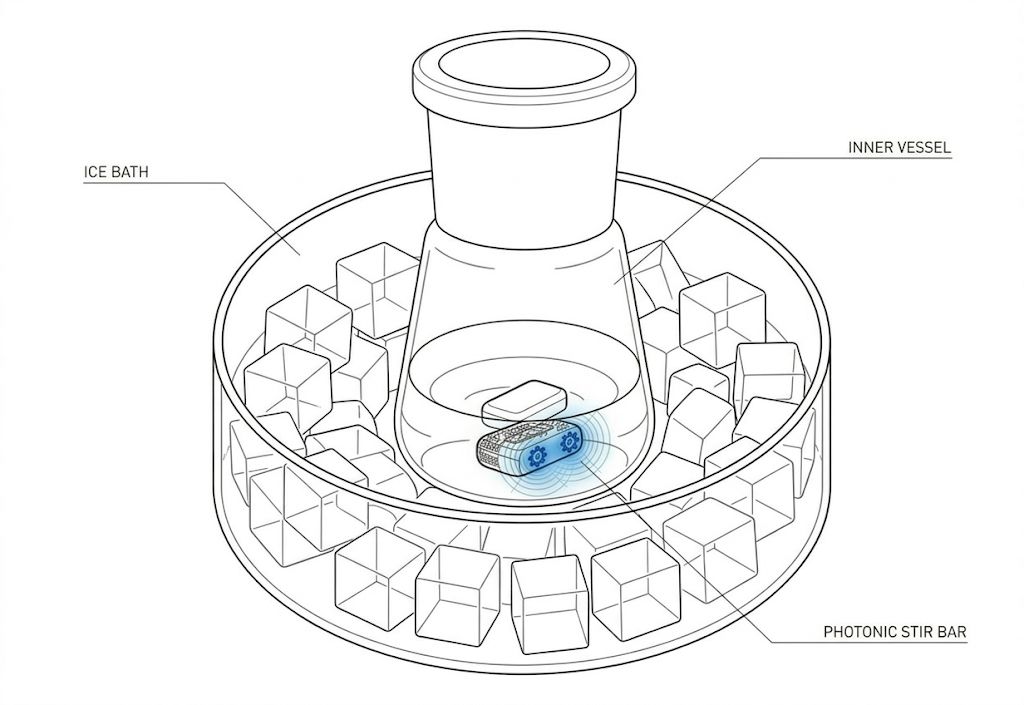
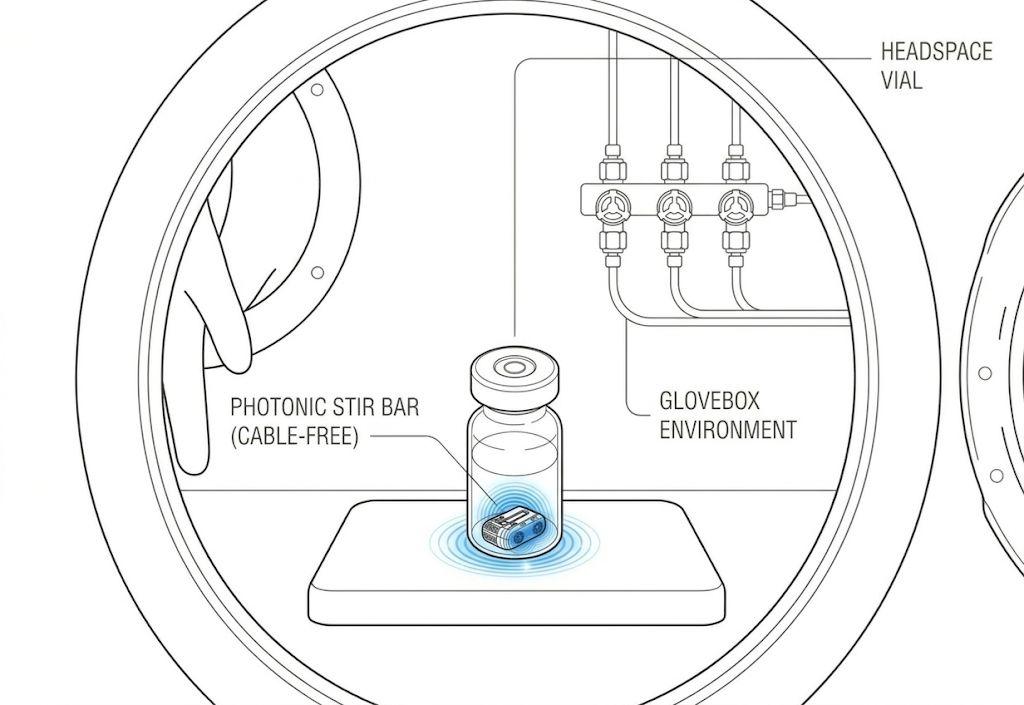
From standard headspace vials to complex inert environments, the Photonic Stir Bar adapts to your workflow—not the other way around. Unlock new workflows and reactions previously restricted by external setups.


Frequently Asked Questions
Which reaction vessels are compatible?
The Photonic Stir Bar is designed for versatility. It works best with flat-bottomed vessels and fits effortlessly into standard 10 mL to 20 mL headspace vials and flat-bottom flasks. Because the light source is inside, even opaque or foil-wrapped vessels can be used. Please note that the use of round-bottomed vessels is currently not supported.
Does it withstand aggressive solvents and reagents?
Yes. The internal electronics are completely encapsulated in a highly resistant fluoropolymer shell (FEP) exhibiting chemical resistance very comparable to PTFE. However, exposure to alkali metals or strong metal-organic bases (e.g., n-BuLi, sodium naphthalenide) known to etch fluoropolymers, as well as highly fluorinated solvents that may cause swelling, should be avoided.
Available Wavelengths?
Besides 450 nm and 365 nm, we are ready to implement many other wavelengths available as LED emitters. – Contact us for details!
Compatible Magnetic Stirrers
The Photonic Stir Bar harvests rotational energy from magnetic stirrers to power its LEDs. To generate the required power, a high-speed stirring plate is essential. We currently approve the following models:
IKA Mixster / Twister
BIOSAN MS-3000 or MMS-3000
We will frequently update this list. If testing other stirring plates, please ensure they can sustain stable speeds of at least 2,500 to 3,000 rpm to ensure functionality.
Does the setup require additional fan cooling?
Because of its high photonic efficiency, the Photonic Stir Bar produces only negligible heat, so external fans (as required with external lamp setups) are generally not required.
What environment temperatures are compatible?
The Photonic Stir Bar is designed for a temperature range of -20°C to +80°C.
Can it be used inside glove boxes?
Yes, absolutely. Because the device is completely wireless, there are no cables to thread through airlocks. The fully encapsulated design is vacuum-safe for standard antechamber cycling. (Note: Please do not heat the device in a drying oven prior to transfer; simply wipe with a dry solvent at room temperature).
How do I clean the device? Is there a risk of cross-contamination?
Thanks to the non-porous FEP encapsulation, it is fully compatible with standard solvent washing and typical acid/base baths, ensuring zero cross-contamination between your runs. However, the device should not be sonicated to prevent internal damage.
What is the lifespan of the device?
The Photonic Stir Bar is a durable piece of lab equipment, not a single-use device. Because it has a durable fluoropolymer shell and is not requiring any batteries, it is ready to provide thousands of hours of reliable operation.
Do you have more questions?
If you have specific requirements for your lab setup, we are ready to discuss details.